This article is part of my Fatal Frame II: Crimson Butterfly Analysis series, focusing on Mio’s psychology in the Crimson Butterfly Ending.
At the end, after coming into contact with Mayu’s feelings, Mio takes on the burden of the ritual herself.
Because the scene is so unforgettable, many players may have wondered: “Why did Mio do that?” “Was this ending a form of salvation, or was it nothing more than a tragic end?”
In this article, I will organize the flow of the ending based on the official setting materials, while explaining and analyzing Mio’s actions.
Please note that this article contains major spoilers for Fatal Frame II: Crimson Butterfly. If you want to review the main story first, I recommend starting with the Fatal Frame II: Crimson Butterfly main story overview before reading this analysis.
Crimson Butterfly Ending | Synopsis
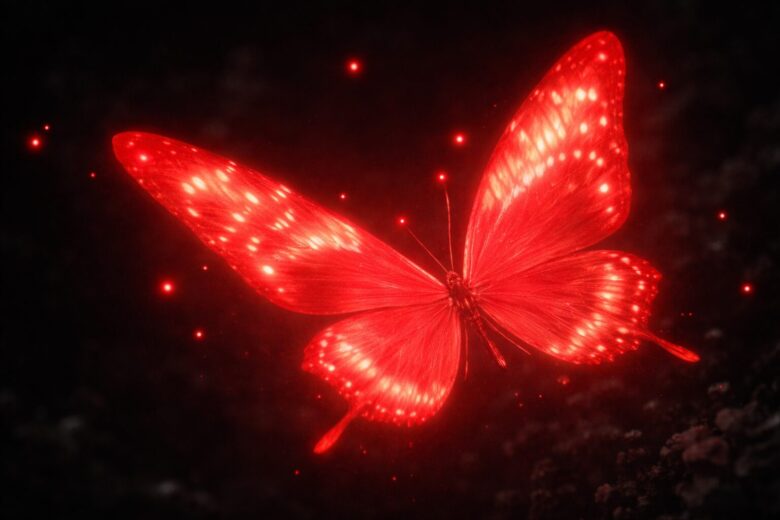
Deep underground, Mio finally reaches the Utsuro.
Mayu stands before the Utsuro.
The time for the ritual is drawing closer with every passing moment.
“Mio…”
“Yae…”
Sae’s voice overlaps with Mayu’s.
“We were born together.
But in the end we live, and die, separately.”
I should have known.
And yet, I couldn’t accept it.
I should have known.
And yet, I couldn’t bring myself to let go.
Facing Mayu, Mio speaks as if offering a prayer.
“Mayu… We’ll be together forever.”
These words are meant to comfort Mayu.
And yet, inside herself, Mio understands the truth as well.
The two of us cannot stay together forever.
Because we were born as separate beings, one day we will have no choice but to part ways in reality.
Before that unavoidable separation, Mayu speaks.
“We can’t be together forever.
But… this will make us one.
So… it’s okay.”
“Kill me.”
The priests around them begin striking their staffs all at once.
The sound of the festival grows hotter and more fevered, and the ritual accelerates toward its end.
At the edge of the Utsuro, Yae overlaps with Mio.
Sae lies on the ritual altar.
Yae slowly reaches toward her neck.
The festival’s sound grows even more intense, until the entire village is swallowed by a single rising fervor.
Yae tightens her hands.
Sae’s body trembles.
Mio tightens her hands.
Mayu’s body trembles.
Mio feels Mayu’s throat beneath her fingers.
And yet, the sensation of touching Mayu also returns to Mio’s own throat at the same time.
— Twins share pain.
At that moment, Mayu’s feelings and Sae’s feelings flow into Mio.
“Why didn’t you kill me back then?
I’ve been waiting for your hands to wrap around my neck…
I kept waiting and waiting.”
The sadness of being left behind.
The thirst to become one.
Those feelings, reaching across a long span of time, fill Mio’s heart.
Something that words could never reach.
Something they had wished for through the words “together forever,” but could never fully give shape to.
At the very edge of death, the boundaries between their hearts finally begin to dissolve.
Through the form of the Crimson Sacrifice Ritual, the twins are able, just once, to receive each other’s pain and feelings in the same place.
The two sink into the depths of darkness.
A place that is nowhere.
A place before names and outlines had separated—
the place where the two of them had once been one.
At last, the ritual ends.
A dull thud echoes, and for a brief moment, everything falls silent.
Mio releases her hands from Mayu in a daze.
Red marks remain on Mayu’s neck, shaped like the prints of both hands.
Those marks soon change form and rise into the air as a single crimson butterfly.
This is how a crimson butterfly is born through the ritual.
The priests’ cheers echo through the chamber.
But Mio alone remains outside the heat of celebration, standing there with her eyes fixed on her own hands.
Then, the butterfly born from Mayu touches Mio’s chest just once.
After that, it rises toward the surface.
“Mayuuu…!”
Mio comes back to herself.
Crying and apologizing, she runs after the butterfly.
As Mio runs across the hill, the butterflies remaining in the village gather and return to the sky.
One of them circles gently around Mio.
Almost as if saying a final goodbye.
After every butterfly has returned, morning light shines into Minakami Village.
The darkness covering the village is swept away, and the spirits trapped there dissolve into the light.
But even after dawn comes, not everything has ended inside Mio.
On the hill as it grows brighter—
Mio collapses alone, left in a morning where Mayu is no longer there.
The light at the end of summer shimmers faintly across the surface of the water.
By the dam lake where Minakami Village has been submerged, Mio continues to think about the meaning of that ritual.
If I had refused back then…
Mayu might truly have broken.
And even if the two of us had escaped the village together…
Maybe she could no longer have remained the Mayu I knew.
There was always something fragile about Mayu, as if she might disappear somewhere in a single passing moment.
Mio had sensed that fragility all along.
As Mio gazes at the lake, Mayu’s voice echoes in her ears.
“Didn’t we always promise each other?
Together…
forever…”
The promise repeated again and again.
It was a prayer: Please don’t leave me.
It was also a wish: Please let me remain inside you.
A bruise like a crimson butterfly appears on Mio’s neck.
It is the same shape as the mark carved into Mayu’s neck.
It shows that Mayu is no longer anywhere in this world.
And at the same time, it proves that Mayu still remains inside Mio.
Mio will go on living alone from here, carrying only Mayu’s presence and their promise.
Why Did Mio Kill Mayu?
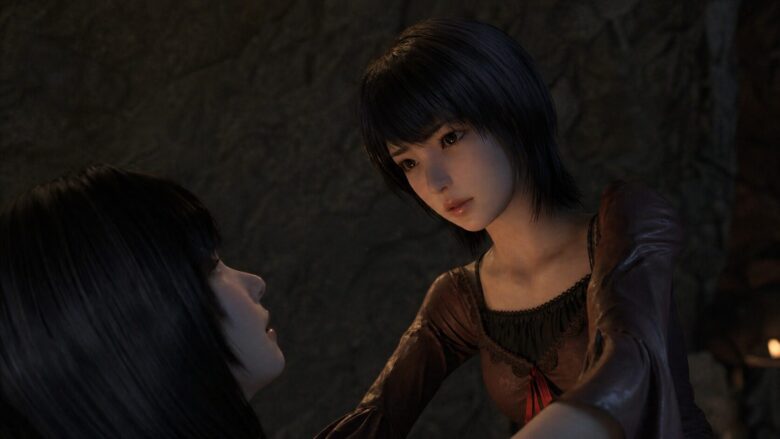
The first thing the Crimson Butterfly Ending confronts us with is the fact that, in the end, Mio ends Mayu’s life with her own hands.
If we look only at this scene by itself, it may seem as though Mio was simply swallowed by the atmosphere of the ritual.
However, this ending cannot be dismissed that simply.
That is because, throughout the main story, Mio has gradually come into contact with what Mayu feared and what Mayu truly wished for.
Before the Utsuro, Mio finally receives the fear Mayu has been carrying, not only through words, but through physical sensation.
- Touching Mayu’s neck
- Feeling pain flow into her
- Feeling the boundary between them begin to waver
In a form she could no longer reject, Mio comes to understand how deeply Mayu had been crushed by the meaning of “Together forever.”
As a result, Mio chooses not to deny Mayu’s feeling of not wanting to be left behind.
Until the very end, Mio never stood in exactly the same place as Mayu.
However, once she understood Mayu’s wish, she could no longer simply abandon her there.
That is why Mio does not choose a future where she and Mayu live together.
Instead, she takes on the burden of the ending that would keep Mayu from suffering any further.
What Mayu Truly Wanted | It Was Not “Living Together”
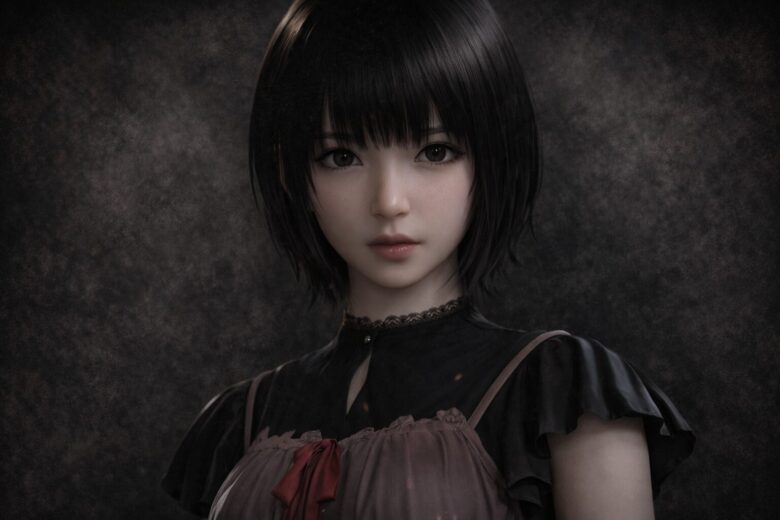
When thinking about the Crimson Butterfly Ending, the first thing we need to clarify is what Mayu truly wished for.
At first glance, it may seem as though Mayu simply wanted to stay together with Mio.
If we look only at words like “Together forever” or “we promised,” they may sound like an innocent wish for two sisters to remain by each other’s side.
However, the wish that becomes visible throughout the main story is not that gentle.
- They were born together and had promised they would always be together.
- And yet, within reality, the more they grew, the more they moved toward slightly different places.
- No matter how close they stayed, they were ultimately separate people, destined one day to die separately.
Mayu’s wish was a denial of separation.
She could not endure the unavoidable reality that she and Mio would continue living as separate beings.
It was a distance that could not be closed simply by living together, getting along, and staying close.
If the wish is “to live together,” then there is still a future in which two separate people support each other while accepting that they remain separate.
But once the center of the wish becomes “I do not want to be separated,” that wish gradually tilts toward ceasing to exist as separate beings at all.
At the end of that path lies the line Mayu speaks in the Crimson Butterfly Ending:
“But… this will make us one.”
At the edge of the Utsuro, Mayu is no longer seeking a future in which they continue walking through reality.
Reality would force the two of them to move forward as separate beings.
If so, then they would have to cross beyond reality itself.
Because they could not live together, Mayu tried to become one with Mio in another form.
That wish was far too closed.
And far too desperate.
And what Mio touched at the end was surely that very desperation.
What Mayu wanted was not to be separated from Mio.
No matter what form it took, she wanted the two of them to avoid becoming separate.
From the very beginning, what Mayu sought was something that could not fit within the boundaries of “living.”
Mio Did Not “Accept” Mayu’s Wish — She Took It Upon Herself
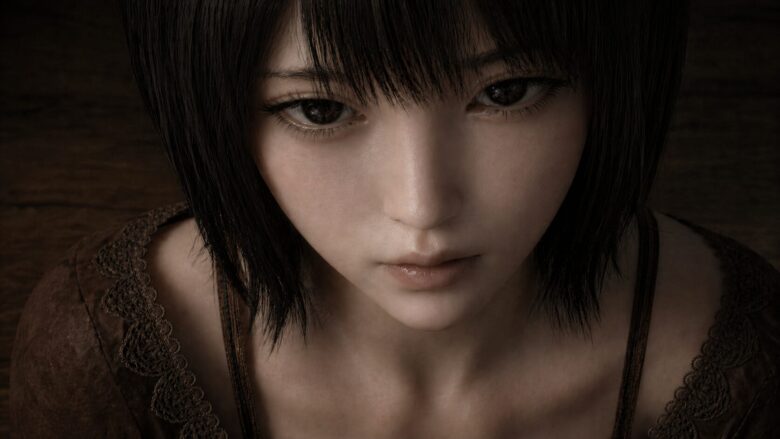
When thinking about Mio in the Crimson Butterfly Ending, we need to choose our words carefully.
It is true that, in the end, Mio did not reject Mayu’s feelings.
However, if we simply say that she “accepted” them, the word feels a little too gentle.
That is because Mio did not wish to become one with Mayu with the same intensity as Mayu herself.
Although Mio had gradually moved closer to the fear Mayu carried throughout the main story, she had not been standing in the same place as Mayu from the beginning.
For that reason, Mio did not act because she had fully understood every part of Mayu’s wish.
Rather, after feeling the weight of that wish, she became unable to reject it.
That is why the word “took it upon herself” feels closer to this ending than “accepted.”
The word “accept” carries the nuance of understanding the other person’s feelings, acknowledging them, and receiving them calmly.
But Mio in the Crimson Butterfly Ending does not seem to have taken Mayu’s wish into herself in such a clean, orderly way.
Her response was heavier.
More painful.
It was closer to this:
“I will take responsibility for where that wish leads.”
- losing Mayu
- being the only one left behind
- continuing to carry this feeling for the rest of her life
Mio took all of this upon herself through an act of self-sacrifice.
What we should remember here is that Mio is left alone by the dam lake, continuing to think about what happened.
If she had truly only accepted Mayu’s wish, she probably would not have continued carrying the pain of the one left behind so intensely.
Mio did not end Mayu because she was satisfied with what she had done.
- She could not affirm Mayu’s wish as her own.
- But she could not reject Mayu, either.
That is why the Crimson Butterfly Ending is best understood not as an ending where Mio accepted Mayu’s wish, but as an ending where she ended up taking it upon herself.
The Meaning of Strangling in the Crimson Butterfly Ending
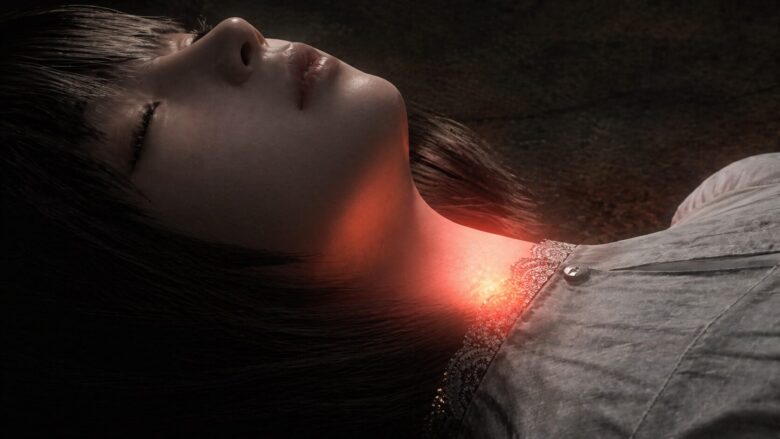
When thinking about the Crimson Butterfly Ending, the first thing we need to pause on is the act of Mio placing her hands around Mayu’s neck.
In ordinary terms, this is an act of violence that takes another person’s life.
Cruel.
Painful.
And yet, in this story, twins are portrayed as beings who share each other’s sensations.
The act of strangling is not simply one person placing her hands upon the other.
It is a ritual in which pain causes the boundary between them to waver, allowing their boundaries to blur deeply at the very end.
In fact, when Mio touches Mayu’s neck in the Crimson Butterfly Ending, she is not only feeling Mayu’s throat beneath her hands.
The sensation of touching Mayu also returns to Mio’s own neck at the same time.
There is no simple, one-sided feeling of “I am killing the other person.”
Instead, there is a reversal, as if Mio herself is being touched in the same place.
At that moment, Mio is drawn into Mayu’s pain.
The feelings that words could never fully deliver are conveyed to Mio in a shared form.
That is why the Crimson Butterfly Ending cannot be reduced to a merely cruel conclusion.
What the two could never fulfill while alive—
receiving each other’s pain in the same place—
is accomplished there.
Of course, it is far too dangerous to call that salvation.
- ending a life
- sharing pain
- causing the boundary to waver
- allowing their feelings to meet only at the very end
In this story, placing one’s hands around someone’s neck becomes almost like carving one’s feelings into the other person.
The birth of the crimson butterfly was also the moment when, as life ended, only the wish to become one was fulfilled.
What Does the Crimson Butterfly Mean?
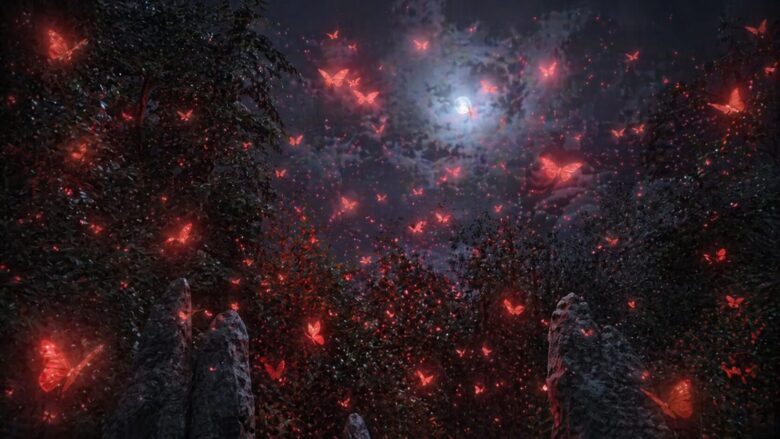
One of the most striking moments in the Crimson Butterfly Ending is the scene where a single crimson butterfly is born from the red marks left on Mayu’s neck by Mio’s hands.
Only through the distorted contact of strangling do the two finally touch the same place.
The crimson butterfly is the trace of that too-late convergence.
The butterfly born from Mayu touches Mio’s chest only once, then rises into the sky.
This scene suggests that Mayu did not simply disappear.
At the very end, she reached Mio one last time—
and only then did she leave.
The crimson butterfly was the completion of the ritual, the trace of their final contact, and the sign of Mayu’s farewell from Mio.
After the crimson butterfly is born, the darkness is swept away, and the trapped spirits return into the morning light.
However, this does not mean we can simply read the birth of the crimson butterfly as salvation.
That is because the butterfly could only be born from the mark left by losing Mayu.
- Morning comes
- The spirits return
- The village is released from the night
And yet, Mayu is no longer by Mio’s side.
What the crimson butterfly brings is the pacification of the village.
At the same time, it is a decisive loss for Mio.
Their wish to make “Together forever” come true could not be fulfilled within reality.
In the end, that wish was fulfilled in exchange for Mayu’s life.
“Zero” is the distance where the boundary between two people disappears.
“The crimson butterfly” is the sign of Mio and Mayu’s parting—and of their overlapping.
In that sense, the Japanese title, Zero: Crimson Butterfly, does not merely name the story.
It names the ending their wish finally reached.
Summary: What Is the Crimson Butterfly Ending?
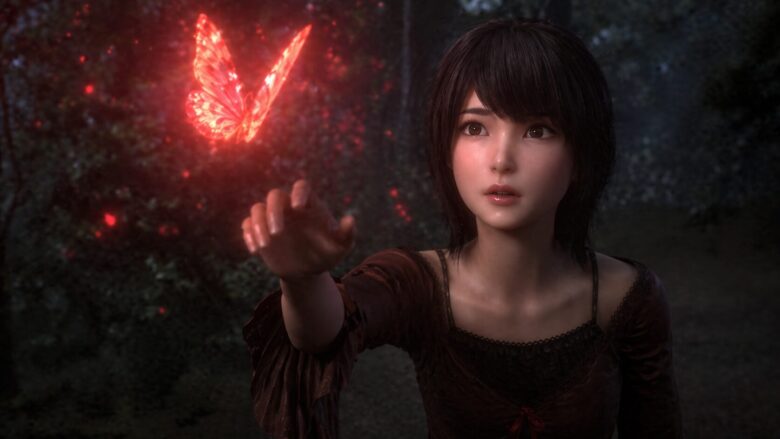
Looking back on everything, we can see that the Crimson Butterfly Ending is neither a simple tragedy nor a simple salvation.
In the end, Mio could not reject Mayu’s feelings.
But she could not save Mayu within life, either.
As a result, Mio took on the destination of Mayu’s wish with her own hands.
The two can no longer live together and walk toward the same future.
Mayu becomes a crimson butterfly and leaves Mio, while Mio is left with a loss that can never be undone.
And yet, Mayu has not simply disappeared.
A bruise remains on Mio’s neck, and Mayu’s voice still echoes:
“Together…
forever…”
Mayu continues to live on inside Mio.
Through pain, at the edge of death, the feelings that words alone could never deliver are finally shared.
The crimson butterfly is the shape taken by that too-late convergence.
The Crimson Butterfly Ending is a conclusion in which the twins’ wish is completed in its most beautiful—and most cruel—form.
If Crimson Butterfly is a conclusion completed by Mio taking Mayu’s wish upon herself, then Lonely Road Home and One Wing are conclusions where that wish could not be fully faced.
Next time, I will examine what the Lonely Road Home / One Wing Endings reveal—the lingering regret and wounds left behind in a world without Mayu.
Thank you for reading, and I hope you will stay with me for the next article.
Fatal Frame II: Crimson Butterfly Analysis Hub
Fatal Frame II: Crimson Butterfly Analysis Series
Analysis Article #2: The Cliff Scene|Why Mio and Mayu See Different Worlds
Analysis Article #5: The Opening Scene|The Unfinished Words and Their Connection to the Endings
Analysis Article #6: Main Story Analysis|How Did Mio Change Throughout the Story?
Analysis Article #7: Crimson Butterfly Ending|Why Did Mio End Up Killing Mayu?
Analysis Article #8: Lonely Road Home / One Wing Endings|Explaining the Price Mio Had to Bear
Analysis Article #9: Frozen Butterfly Ending|Mayu’s Tearful Smile and the Head in the Hina Doll Room
Analysis Article #10: Shadow Festival Ending|Why Did Mio Say, “This Time, We Fall Together”?
Analysis Article #11: The Promise Ending|The Meaning of “I’ll Never Let You Go Again”
Analysis Article #14: Sprouting Wings + Remaining Sun Endings|What It Means for Mio and Mayu to Return Alive
*This article is part of the “Fatal Frame II: Crimson Butterfly Analysis” series.
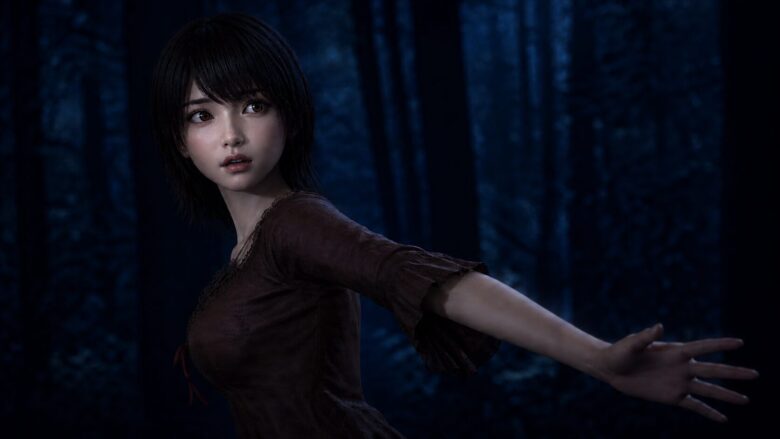
*The images used in this article include unofficial AI-generated images inspired by the world of the game, as well as screenshots from FATAL FRAME II: Crimson Butterfly REMAKE and Project Zero 2: Wii Edition. All rights to Fatal Frame II: Crimson Butterfly belong to Koei Tecmo Games.
*This article refers to certain official materials that are currently difficult to obtain. Their contents are summarized only where necessary for understanding the story, while the article itself focuses mainly on analysis and interpretation.
コメント欄